作者归档:泰宏

Mill Liners & Crusher Wear Parts

Product Overview

Our industrial-grade wearing parts are meticulously engineered to withstand the most severe impact and abrasive environments. Utilizing premium materials—including high chromium cast iron, high manganese steel, and bimetal composites—our mill liners and crusher hammers ensure exceptional durability and outstanding hardness. These high-performance components are designed to maximize processing efficiency while significantly reducing downtime and operational costs.

Crusher Wear Parts (Hammers & Components)

Designed for medium-to-large crushers, clinker crushers, and limestone pulverizers.

Material Name Range Of Application Service Life Hardness Impact Toughness (J/cm²)
Ultra-high Toughness High Chromium Cast Iron
Cr 20%-26%
Clinker, Crusher, And Hammer etc. 2 – 4 Months HRC ≥ 60 7 – 10
Alloy High-manganese Steel
Mn14
Large and medium-sized crusher hammers (Mainly used for crushing limestone, etc.) Varies by clinker nature HB ≥ 220 ≥ 120
Super High-manganese Steel
Mn18
Varies by clinker nature HB ≥ 240 ≥ 120
Alloy High-manganese Shock Surfacing Varies by clinker nature Head: HRC ≥ 56
Handle: ≥ 56
Head: ≥ 56
Handle: ≥ 56
Bimetal Composite Hammers Clinker, Crusher, And Hammer etc. 1.5 Times of traditional hammers Head: HRC ≥ 60
Handle: ≥ 56
Head: ≥ 60
Handle: ≥ 56

Grinding Mill Wear Parts (Liners & Plates)

High-performance lining boards designed for heavy-duty ball mills, vertical mills, and drying chambers.

Material Name Range Of Application Service Life Hardness Impact Toughness (J/cm²)
High Toughness High Chromium Cast Iron ≤ Φ5m Mill Liners, Aside-Liner ≥ 7 Years HRC ≥ 60 8 – 10
High Chromium Cast Iron I ≤ Φ5m Mill Liners, Vertical Mill Lining Board ≥ 6 Years HRC ≥ 60 7 – 9
High Chromium Cast Iron II ≤ Φ5m Mill Liners, Powder Concentrator Lining ≥ 5 Years HRC ≥ 58 6 – 8
High Chromium Cast Iron III ≤ Φ4.2m Mill Liners, Aside-Liner Partition Board ≥ 4 Years HRC ≥ 55 6 – 9
Chromium Platinum Nickel Alloy Steel ≤ Φ5m Mill Liners, Aside-Liner, Partition Board, Counterattack Plate, etc. ≥ 4 Years HRC ≥ 52 ≥ 40
Medium Carbon Alloy Steel ≥ 3 Years HRC ≥ 50 ≥ 30
Medium-chromium Alloy Steel ≥ 2 Years HRC ≥ 48 ≥ 20
Low Chromium Alloy Steel ≥ 1.5 Years HRC ≥ 45 ≥ 40
Low Carbon High Chromium Alloy Steel Mine Wet Mill Liner, Aside-Liner, Gratings in Large Raw Mill, Blind Plate of Drying Chamber ≥ 1 Year to ≥ 3 Years HRC ≥ 46 ≥ 50
High Manganese Steel
Mn13
Mine Wet Mill Liner, Aside-Liner, Gratings ≥ 8 Months HB ≥ 200 ≥ 147
Alloyed High Manganese Steel
Mn13Cr2
≤ Φ5m Mill Liners, Aside-Liner ≥ 1 Year HB ≥ 200 ≥ 120

Steel Grinding Rods

Product Overview

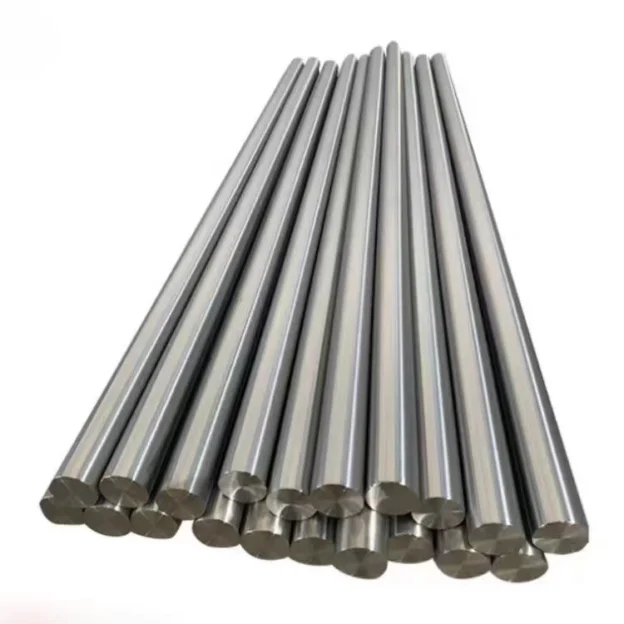
Our premium wear-resistant steel grinding rods are manufactured using advanced medium-frequency induction heating, coupled with precise quenching and tempering processes. Featuring an optimal balance of surface hardness and mechanical properties, they are engineered to deliver exceptional wear resistance, high impact toughness, and industry-leading straightness to significantly lower your single-ton milling costs.

Advanced Manufacturing Process

✓ Premium Raw Materials
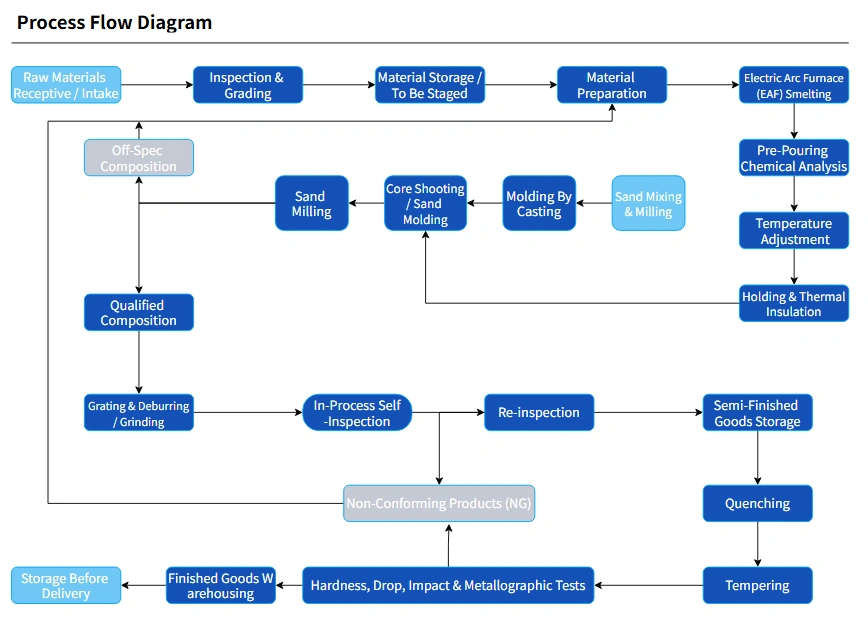
Strict inspection and grading of raw materials to guarantee the structural integrity and uniformity of our grinding rods.
✓ Double Heat Treatments
Medium-frequency furnace heating followed by precise quenching & tempering ensures consistent surface-to-core hardness.
✓ Exceptional Straightness
Advanced online straightening keeps the non-straightness strictly under 0.2%, preventing bending and premature failure.

Factory Production & Inspection Flowchart


Figure: Closed-loop manufacturing and rigorous quality inspection flow for premium steel grinding rods.

💡 Standard Compliance: Non-straightness of grinding rods is strictly controlled within < 0.2%. Diameter tolerance: +0 / -25mm, with an exceptionally low fracture rate of < 3%.

Mechanical Properties

Grinding Rod Diameter & Length (mm) Surface Hardness (HRC) Impact Toughness [AK] (J/cm²) Strength of Extension (Mpa/mm²)
Φ50-110 (2.5m – 6m) 45 – 55 ≥ 12 ≥ 1000

High Chromium Casting Steel Cylpebs

Product Overview

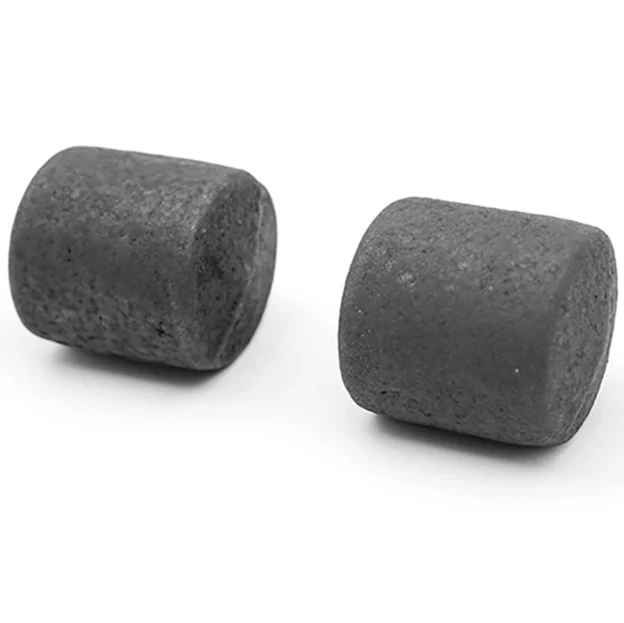
Our wear-resistant casting steel cylpebs (grinding cylpebs) are strictly manufactured via advanced electric furnace smelting and precisely monitored thermal treatments. Designed with a unique cylindrical line-contact geometry, these cylpebs offer a larger surface area per unit volume than balls, ensuring higher grinding efficiency, precise particle size distribution, and significantly reduced milling costs.

Advanced Manufacturing Process

✓ Precise Melt Control
Electric-furnace smelting paired with real-time spectrum analysis ensures the precise chemical composition of chromium (up to 30%).
✓ Double-Gate Inspection
Features a strict self-inspection and professional recheck system. Any non-qualified semi-finished products are 100% rejected and remelted.
✓ Multi-Dimensional QC Testing
Every batch undergoes 5 rigorous final tests: Hardness, Falling Sphere, Impact, and Metallography, ensuring ≥ 22,000 times fatigue life.

Chemical Composition (%)

Grade C Si Mn Cr Mo Cu Ni P S
ZOCr26 2.0-3.3 ≤1.2 0.3-1.5 23.0-30.0 0-3.0 0-1.2 0-1.5 ≤0.10 ≤0.06
ZOCr20 2.0-3.3 ≤1.2 0.3-1.5 18.0-23.0 0-3.0 0-1.2 0-1.5 ≤0.10 ≤0.06
ZOCr15 2.0-3.3 ≤1.0 0.3-1.5 14.0-18.0 0-3.0 0-1.2 0-1.5 ≤0.10 ≤0.06
ZOCr12 2.0-3.3 ≤1.2 0.3-1.5 10.0-14.0 0-3.0 0-1.2 0-1.5 ≤0.10 ≤0.06
ZOCr8 2.1-3.3 ≤1.2 0.3-1.5 6.0-10.0 0-1.0 0-0.8 ≤0.10 ≤0.06
ZOCr5 2.1-3.3 ≤2.2 0.3-1.5 3.0-6.0 0-1.0 0-0.8 ≤0.10 ≤0.10
zOCr2 2.1-3.5 ≤1.5 0.3-1.5 1.0-3.0 0-1.0 0-0.8 ≤0.10 ≤0.10

Mechanical Properties & Microstructure

Grade Surface Hardness (HRC) Core Hardness (HRC) Microstructure Falling Fatigue Life (Times) Impact Toughness (J/cm²)
ZOCr26 > 58 > 56 M+C ≥ 22000 ≥ 6
ZOCr20 > 58 > 56 M+C ≥ 22000 ≥ 6
ZOCr15 > 58 > 56 M+C ≥ 22000 ≥ 6
ZOCr12 > 58 > 56 M+C ≥ 20000 ≥ 6
ZOCr8 > 50 > 48 P+C ≥ 15000 ≥ 6
ZOCr5 > 48 > 46 P+C ≥ 12000 ≥ 6
zOCr2 > 46 > 45 P+C ≥ 10000 ≥ 6

💡 Application Note: Our casting steel cylpebs provide a distinct line-contact grinding mechanism instead of point-contact. They are highly recommended for the fine-grinding stages in cement mill chambers, silica sand processing, and metal mining concentrating mills to optimize grinding fineness and save energy.

Casting Chrome Steel Ball

2Product Overview

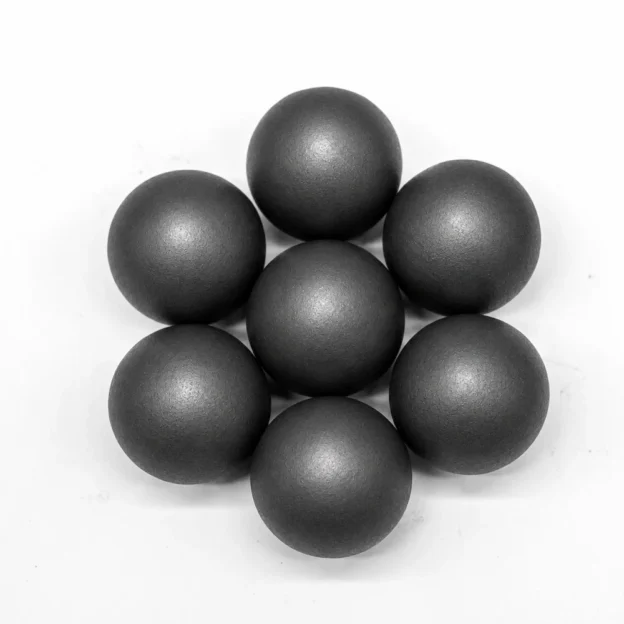
Our wear-resistant casting steel balls are strictly manufactured via advanced electric furnace smelting and precisely monitored thermal treatments. With stable chemical compositions ranging from ZCr2 to ZCr26, they ensure exceptional surface and core hardness balance to significantly lower your single-ton milling costs.

Advanced Manufacturing Process

✓ Precise Melt Control
Electric-furnace smelting paired with real-time spectrum analysis ensures the precise chemical composition of chromium (up to 30%).
✓ Double-Gate Inspection
Features a strict self-inspection and professional recheck system. Any non-qualified semi-finished products are 100% rejected and remelted.
✓ Multi-Dimensional QC Testing
Every batch undergoes 5 rigorous final tests: Hardness, Falling Sphere, Impact, and Metallography, ensuring ≥ 22,000 times fatigue life.
01

Raw Materials

Strict inspection & grading of incoming steel scrap.

02

EAF Smelting

Advanced electric arc furnace melting with spectroanalysis.

03

Precision Molding

Automated sand molding ensures dimensional tolerance.

04

Dual Heat Treatment

Precise Quenching & Tempering for balanced hardness.

05

Rigorous QC

100% testing on Hardness, Drop Fatigue & Metallography.

06

Dispatch

Secure packaging and storage before global shipping.

💡 Quality Assurance: Our closed-loop testing system ensures that any sub-standard semi-finished products are immediately rejected and remelted, guaranteeing 100% qualified products delivery.

Factory Production & Inspection Flowchart

Casting Steel Grinding Balls Process Flow Diagram

Figure: Closed-loop production and rigorous quality inspection flow for premium grinding balls.

Chemical Composition (%)

Grade C Si Mn Cr Mo Cu Ni P S
ZCr26 2.0-3.5 ≤1.2 0.3-1.5 23.0-30.0 0-3.0 0-1.2 0-1.5 ≤0.10 ≤0.06
ZCr20 2.0-3.5 ≤1.2 0.3-1.5 18.0-23.0 0-3.0 0-1.2 0-1.5 ≤0.10 ≤0.06
ZCr15 2.0-3.5 ≤1.2 0.3-1.5 14.0-18.0 0-3.0 0-1.2 0-1.5 ≤0.10 ≤0.06
ZCr12 2.0-3.5 ≤1.2 0.3-1.5 10.0-14.0 0-3.0 0-1.2 0-1.5 ≤0.10 ≤0.06
ZCr8 2.0-3.5 ≤1.2 0.3-1.5 6.0-10.0 0-1.0 0-0.8 0-1.5 ≤0.10 ≤0.06
ZCr5 2.0-3.5 ≤1.2 0.3-1.5 3.0-6.0 0-1.0 0-0.8 0-1.5 ≤0.10 ≤0.10
ZCr2 2.0-3.5 ≤1.2 0.3-1.5 1.0-3.0 0-1.0 0-0.8 0-1.5 ≤0.10 ≤0.10

Mechanical Properties & Microstructure

Grade Surface Hardness (HRC) Core Hardness (HRC) Microstructure Falling Fatigue Life (Times) Impact Toughness (J/cm²)
ZCr26 > 58 > 56 M+C ≥ 22000 ≥ 6
ZCr20 > 58 > 56 M+C ≥ 22000 ≥ 6
ZCr15 > 58 > 56 M+C ≥ 22000 ≥ 6
ZCr12 > 58 > 56 M+C ≥ 20000 ≥ 6
ZCr8 > 50 > 48 P+C ≥ 15000 ≥ 6
ZCr5 > 48 > 46 P+C ≥ 12000 ≥ 6
ZCr2 > 46 > 45 P+C ≥ 10000 ≥ 6

Full Size Specifications

Diameter (mm) Single Weight (kg) Pcs Per Ton Tolerance (mm) Diameter (mm) Single Weight (kg) Pcs Per Ton Tolerance (mm)
Φ4.8 0.00064 1562500 ±1.0 Φ50 0.50 2000 +1.5 / -1.0
Φ6.32 0.00112 892857 ±1.0 Φ60 0.867 1153 +1.5 / -1.0
Φ8 0.00232 431034 ±1.0 Φ70 1.37 729 +2.0 / -1.0
Φ10 0.00388 257731 ±1.0 Φ80 2.05 487 +2.0 / -1.0
Φ12 0.00771 129702 ±1.0 Φ90 2.90 345 +2.3 / -1.0
Φ15 0.015 68273 ±1.0 Φ100 4.00 250 +2.3 / -1.0
Φ17 0.021 41982 ±1.0 Φ110 5.30 188 +3.0 / -1.0
Φ20 0.034 31056 ±1.0 Φ120 6.80 147 +3.0 / -1.0
Φ25 0.063 15873 ±1.0 Φ125 7.75 129 +3.0 / -1.0
Φ30 0.11 9091 ±1.0 Φ130 8.74 114 +3.0 / -1.0
Φ40 0.257 3891 +1.5 / -1.0 Φ150 13.83 72 +3.0 / -1.0

Forged and Hot Rolled Steel Ball

Product Overview

Our forged and hot-rolled steel balls are engineered for high-impact and low-wear mining and milling applications. Utilizing premium round steel bars as raw materials, these grinding balls undergo advanced precision forging or automated hot-rolling processes. This ensures an exceptionally dense internal structure, precise dimensional tolerance, and an optimal volumetric hardness balance, significantly reducing your grinding cost per ton.

Advanced Manufacturing Processes

We offer two advanced production methodologies to meet different volumetric and operational requirements. Both processes ensure zero internal defects and maximum resistance to deformation.

✓ Premium Top-Grade Raw Materials
Strictly utilizes high-quality alloy round steel bars (such as 60Mn, 65Mn, B2, B3) from leading steel mills to guarantee consistent chemical stability from the source.
✓ Uniform Microstructure & Hardness
Advanced precise quenching and thermal tempering cycles result in a fully refined Martensite + Bainite + Carbide microstructure with excellent surface-to-core hardness balance.
✓ High Impact Toughness & Zero Breakage
Delivers superior impact toughness (up to ≥26 J/cm²) and an outstanding falling fatigue life of ≥22,000 times, ensuring a near-zero breakage rate during heavy-duty operations.

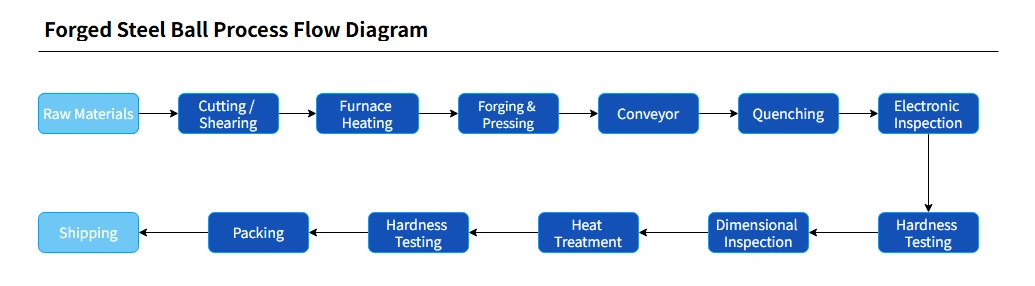
Method A: Forging Steel Ball Process Flowchart

Traditional precision air hammer forging for robust performance and high density.

Forging Steel Ball Process Flow Diagram

Flow: Raw Material → Cut Off → Heating Furnace → Forge & Press → Conveyer → Quench → QC Inspections → Thermal Treatment → Packing & Shipping

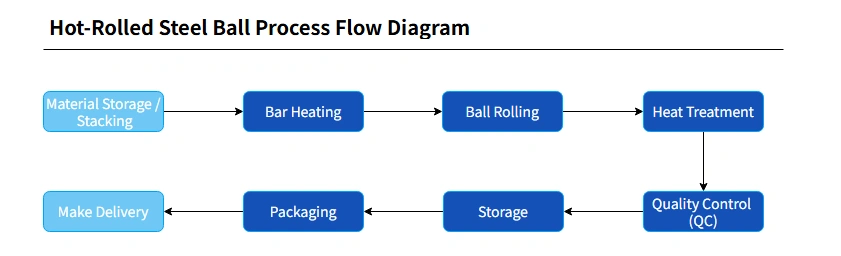
Method B: Hot Rolled Steel Ball Process Flowchart

Highly automated skew rolling mill production line for exceptional dimensional precision and large scale capacity.

Hot Rolled Steel Ball Process Flow Diagram

Flow: Material Placing → Bar Heating → Ball Rolling → Thermal Treatment → Quality Control → Storage → Packaging & Delivery

Chemical Composition (%)

Grade / Material C Si Mn P S Cr
45# 0.42-0.48 0.17-0.37 0.50-0.80 ≤0.035 ≤0.035 ≤0.25
60Mn 0.57-0.65 0.17-0.37 0.70-1.00 ≤0.035 ≤0.035 ≤0.25
65Mn 0.62-0.70 0.17-0.37 0.90-1.20 ≤0.035 ≤0.035 ≤0.25
B2 0.75-0.85 0.17-0.35 0.70-0.90 ≤0.030 ≤0.030 0.40-0.60
B3 0.55-0.65 0.20-0.37 0.75-0.90 ≤0.030 ≤0.030 0.85-1.20
B4 0.58-0.66 1.60-1.90 0.65-0.80 ≤0.030 ≤0.030 0.70-0.90
B6 0.97-1.03 0.20-0.30 1.00-1.10 ≤0.025 ≤0.025 0.50-0.60

Mechanical Properties & Microstructure

Material Impact Toughness
(J/cm²)
Falling Fatigue Life
(Times)
Hardness (Φ25mm-Φ50mm) Hardness (Φ60mm-Φ90mm) Hardness (Φ100mm-Φ150mm)
Surface Inner Core Surface Inner Core Surface Inner Core
45# ≥ 16 ≥ 22000 ≥ 54 ≥ 36 ≥ 54 ≥ 34 ≥ 52 ≥ 30
60Mn ≥ 15 ≥ 22000 ≥ 60 ≥ 45 ≥ 60 ≥ 43 ≥ 60 ≥ 40
65Mn ≥ 15 ≥ 22000 ≥ 62 ≥ 46 ≥ 62 ≥ 44 ≥ 62 ≥ 42
B2 ≥ 18 ≥ 22000 ≥ 62 ≥ 57 ≥ 62 ≥ 55 ≥ 62 ≥ 50
B3 ≥ 20 ≥ 22000 ≥ 62 ≥ 60 ≥ 62 ≥ 58 ≥ 62 ≥ 58
B4 ≥ 24 ≥ 22000 ≥ 62 ≥ 60 ≥ 62 ≥ 58 ≥ 62 ≥ 58
B6 ≥ 26 ≥ 22000 ≥ 62 ≥ 60 ≥ 62 ≥ 58 ≥ 62 ≥ 58

Full Size Specifications

Diameter
(mm)
Single Weight
(kg)
Pcs Per Ton
(piece)
Tolerance
(mm)
Diameter
(mm)
Single Weight
(kg)
Pcs Per Ton
(piece)
Tolerance
(mm)
Microstructure
Φ20 0.033 30303 +1 / -0.5 Φ90 3.0 333 +3 / -2 Martensite +
Bainite +
Carbide
(马氏体 + 贝氏体 + 碳化物)
Φ25 0.064 15625 +1.5 / -0.5 Φ100 4.1 244 +3 / -2
Φ30 0.11 9090 +1.5 / -0.5 Φ110 5.47 183 +4 / -3
Φ40 0.26 3846 +2 / -1 Φ120 7.1 141 +4 / -3
Φ50 0.51 1961 +2 / -1 Φ130 9.02 111 +4 / -3
Φ60 0.89 1124 +2 / -1 Φ140 11.25 88 +4 / -3
Φ70 1.4 714 +3 / -2 Φ150 13.83 72 +4 / -3
Φ80 2.1 476 +3 / -2

💡 Application Note: Our Forged and Hot-Rolled steel balls are highly recommended for large-scale SAG mills, ball mills, and regrind mills in copper, gold, iron, and cement plants due to their incredible shatter resistance.

Recognized for Excellence: Sister Company Huahong Awarded “2026 Smart Factory” Status

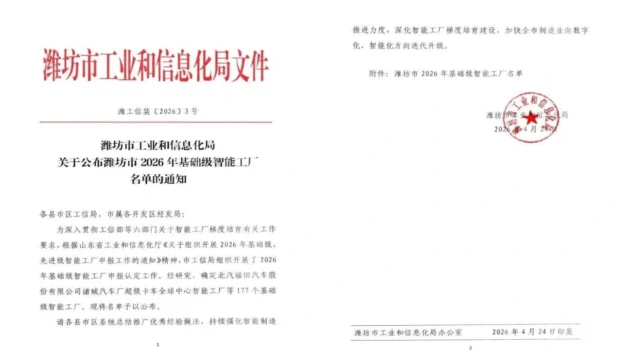
[Qingzhou, China] — The Weifang Municipal Bureau of Industry and Information Technology officially released the 2026 List of Foundation-Level Smart Factories. We are proud to announce that our sister company, Qingzhou Huahong Wear-Resistant Materials Co., Ltd., has been successfully recognized for its High-End Wear-Resistant Materials Smart Manufacturing Factory project.

Official Recognition & Public Listing

Official Government Notice (Weifang MIIT [2026] No. 3)

Official Listing: High-End Wear-Resistant Materials Smart Factory

What Smart Manufacturing Means for Our Alloy Quality

Smart factories represent the integration of advanced manufacturing equipment, industrial software, and interconnected systems. By linking production devices with real-time data management, our manufacturing facilities achieve comprehensive optimization across the entire product lifecycle—from raw material melting to final heat treatment.

Empowering TaiHong & Global Partners:

  • Uncompromising Material Integrity: Automated melting and heat-treatment controls guarantee precise chemical composition and microstructure for every batch.
  • Higher Production Efficiency: Interconnected workshop systems reduce lead times and streamline supply chain management for large-scale industrial orders.
  • Traceable Quality Assurance: Full product lifecycle tracking ensures that mill liners, grinding media, and wear parts meet rigorous international standards.

Driving High-Quality Growth in Wear-Resistant Solutions

As part of our broader group strategy, TaiHong will continue to share technological innovations and smart manufacturing best practices with Huahong. Together, we are committed to delivering high-performance, long-lasting wear solutions to mining, cement, and power-generation clients worldwide.

TaiHong Selected for the 2025 Shandong Leading New Materials Enterprise Repository

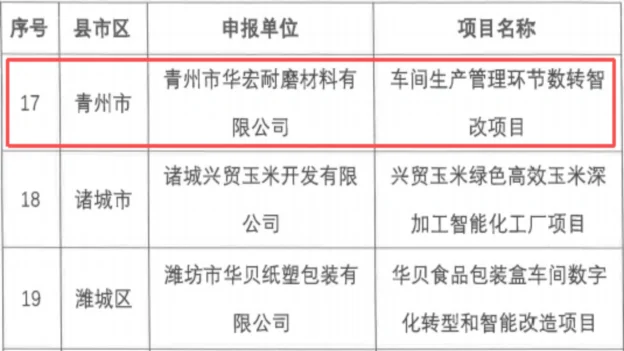
[Qingzhou, China] — The Weifang Municipal Bureau of Industry and Information Technology officially issued the Notice on the Announcement of the 2025 Industrial Digital Transformation and Intelligent Upgrading Award & Subsidy Project List. Qingzhou Taihong Wear-Resistant Materials Co., Ltd. successfully made the official list for its outstanding achievement in the “Workshop Production Management Digital Transformation and Smart Upgrading Project”.

Official Recognition & Project Listing

Official Document (Weifang MIIT [2025] No. 5)

Item #17: Workshop Production Management Smart Upgrade

Driving Metallurgical Excellence Through Smart Manufacturing

This government designation underscores Huahong’s commitment to modernizing production workflows, optimizing workshop management, and implementing advanced data-driven quality control in the casting and processing of high-performance wear-resistant alloys.

How Smart Transformation Benefits Our Global Clients:

  • Precision Quality Control: Digitized workshop management ensures consistent alloy compositions, optimized heat treatment parameters, and superior structural integrity for every batch.
  • Enhanced Production Efficiency: Smart manufacturing reduces lead times and boosts supply chain reliability for severe-impact and high-wear components.
  • Advanced Alloy Expertise: Continuous technology upgrades empower superior engineering in high-chromium cast iron, alloyed manganese steel, and bimetallic composites.

Empowering Global Mining & Industrial Operations

Looking ahead, Huahong will accelerate its digital and intelligent transformation to supply exceptionally durable, high-efficiency grinding media and customized mill liner solutions for mining, cement, and power-generation partners worldwide.

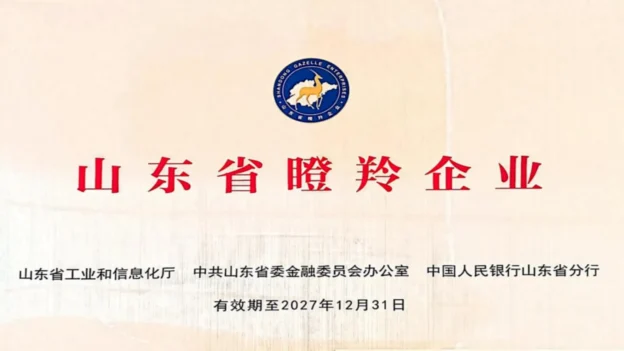
TaiHong Awarded Shandong Gazelle Enterprise & Drives $14M+ R&D Innovation

[Qingzhou, China] — Qingzhou TaiHong Wear-Resistant Materials Co., Ltd. has officially been named a “Shandong Gazelle Enterprise” by the Department of Industry and Information Technology of Shandong Province. This prestigious honor highlights TaiHong’s rapid growth, technological innovation, and expanding leadership in the global wear-resistant materials sector.


💡 What is a “Gazelle Enterprise”?

Named after the fast and agile antelope, a Gazelle Enterprise refers to a high-growth, technology-driven business that has successfully scaled past the startup phase. Recognized for its rapid revenue growth, high R&D investment, and disruptive technological advancements, a Gazelle Enterprise represents the benchmark of industrial excellence and long-term competitiveness.

Industrial Scale & Advanced Manufacturing Excellence

As a recognized National High-Tech Enterprise, TaiHong stands as one of China’s premier manufacturers of wear-resistant grinding media. By seamlessly integrating state-of-the-art casting, forging, and hot-rolling processes, our facility boasts an annual production capacity of 300,000 metric tons. We supply high-performance forged and hot-rolled steel balls, cast grinding balls, grinding rods, cylpebs, mill liners, and crusher hammers to global mining, power, and cement industries.

Recent R&D Milestones & Technological Breakthroughs:

  • $14M+ Joint R&D Initiative with USTB: TaiHong partnered with the Collaborative Innovation Center of Steel Technology at the University of Science and Technology Beijing (USTB) on a 102 million RMB project. Focusing on advanced metallurgical microstructural control, this collaboration expands our high-end mechanical components capacity by 200,000 metric tons annually.
  • Patented Casting Separation Technology: Secured a national invention patent for our proprietary “Rotary Riser and Casting Separation Method and Equipment”, drastically improving casting precision, structural integrity, and manufacturing efficiency.
  • Major Energy Sector Procurement Win: Awarded the competitive supply contract for Tianjin Guoneng Panshan Power Generation Co., Ltd., reinforcing top-tier energy corporations’ trust in our durable wear solutions.

Commitment to Global Standards & Continuous Innovation

Receiving the “Gazelle Enterprise” designation—alongside continuous university research partnerships and patented manufacturing technologies—validates TaiHong’s relentless pursuit of metallurgical excellence. Moving forward, we will continue expanding our R&D capabilities and production scale to deliver low-wear, low-breakage grinding media engineered for the most demanding global operational environments.

High-Efficiency Grinding Media & Wear Solutions for Fiber Cement Plants

Fiber cement manufacturing—used globally for high-durability siding, architectural panels, and silicate boards—requires precise wet raw material preparation. Unlike dry cement clinker grinding, the raw material preparation in fiber cement plants involves wet grinding of highly abrasive silica sand (quartz) combined with calcium sources and cellulose fibers.

Selecting grinding media for fiber cement plants requires resolving the complex interplay of high-stress quartz slurry abrasion, wet alkaline corrosion, and strict particle size distribution control. Tailoring grinding alloys to raw silica hardness and wet ball mill dynamics is critical to optimizing slurry reactivity, reducing media wear costs, and ensuring smooth downstream sheet-forming (Hatschek) processes.


1. Key Fiber Cement Manufacturing Characteristics & Media Selection Logic

A. Extreme Quartz Sand Abrasion in Wet Slurry (Micro-Cutting Wear)

  • Operating Condition: Silica sand (SiO₂ > 80%–90%) processed in wet ball mills acts as a liquid abrasive paste. Quartz particles with a Mohs hardness of 7.0 exert severe micro-cutting and scratching on grinding media surfaces.
  • Selection Logic: Standard carbon steel or low-alloy forged balls undergo rapid surface gouging, resulting in flat-spotting, excessive media consumption (g/ton), and frequent, costly mill charge replenishments.
  • Engineered Match: High-Carbide High-Chrome Cast Balls (Cr 12%–18%). Embedded with dense M₇C₃ chromium carbides (microhardness 1,200–1,800 HV), these alloys deliver supreme resistance to silica sand cutting wear.

B. Wet Slurry Chemistry & Metal Oxidation (Corrosive-Abrasive Synergy)

  • Operating Condition: Wet grinding slurries containing lime, cement, and quartz operate in a alkaline to mildly alkaline aqueous environment (pH 8.0–11.0). Continuous wet tumbling creates a synergistic wear mechanism where chemical oxidation continuously strips soft metal oxides from the ball surface.
  • Selection Logic: Unalloyed steel balls corrode rapidly in wet slurries, generating excessive tramp iron rust (Fe₂O₃) that stains raw slurry and compromises board aesthetics.
  • Engineered Match: Passivated High-Chrome Alloy Media (Cr 14%–22%). High chromium content forms a continuous, self-passivating oxide film that effectively suppresses electrochemical wear and prevents slurry discoloration.

C. Strict Fineness Range & Prevention of Over-Grinding (Particle Liberation)

  • Operating Condition: Autoclaved calcium silicate boards require an optimal silica fineness (typically passing 200 mesh at 85%–95%) to react efficiently with calcium hydroxide during hydrothermal curing. However, generating excess slimes (ultra-fines) reduces slurry drainability during board forming.
  • Selection Logic: Media must provide controlled, surface-contact grinding rather than brutal impact to achieve tight target particle size distribution (PSD).
  • Engineered Match: High-Chrome Cylpebs & Small-Diameter Micro Balls (Ø15mm–Ø30mm / Cylpebs). Cylpebs offer line-contact surface area, optimizing fine quartz reduction, improving slurry reactivity, and preventing over-grinding.

2. Media Selection Matrix Tailored to Fiber Cement Raw Material Circuits

Application Circuit Fiber Cement Slurry Challenge Primary Selection Metric Recommended Media Type Alloy & Hardness Profile
Primary Sand Slurry Mill Coarse silica sand feed, wet slurry impact Impact Toughness + Abrasion Resistance High-Chrome Alloy Cast Balls (Ø40–Ø60mm) Cr 12%–15% High Chrome Alloy (60–64 HRC)
Secondary / Fine Silica Mill Severe quartz abrasion, wet alkaline environment Corrosion-Abrasive Wear Resistance High-Chrome Cast Balls (Ø25–Ø40mm) Cr 15%–18% High Chrome Alloy (62–65 HRC)
Fine Regrind & Slurry Homogenization Target fineness (passing 200 mesh), preventing slimes High Surface Contact Area + Low Iron Release High-Chrome Cylpebs / Micro Balls (Ø15–Ø25mm) Cr 18%–22% High Chrome Alloy (63–66 HRC)

3. Measurable Financial & Operational Benefits

  • 50%–65% Lower Specific Media Consumption: Replacing standard low-alloy forged balls with engineered high-chrome cast media slashes consumption rates in wet quartz slurry.
  • Enhanced Hydrothermal Reactivity: Precise silica particle size distribution optimizes the pozzolanic reaction with lime in autoclaves, improving final board flexural strength (MOR).
  • 10%–15% Improved Board Dewatering Speed: Controlled particle size distribution prevents excessive fines, allowing faster drainage on Hatschek forming machines and increasing line speeds.
  • Clean Slurry & Zero Staining: Corrosion-resistant chromium alloys eliminate free iron rust contamination, maintaining natural board whiteness and color consistency.

4. Operational Case Study: 15,000,000 m²/Year Fiber Cement Board Plant

Plant Profile: A major fiber cement manufacturer operating wet ball mills to prepare quartz sand slurry (target fineness 90% passing 200 mesh) for autoclaved calcium silicate board production.

The Problem: The plant was using standard carbon steel forged balls. High quartz slurry abrasion combined with wet corrosion resulted in rapid ball wear (820 g/ton of dry sand). Severe flat-spotting reduced grinding efficiency, and iron rust generation caused board surface discoloration.

The Tailored Solution: Transitioned wet sand ball mills to Cr 16% High-Chrome Cast Balls (Ø30mm / Ø40mm dynamic ratio) and introduced Cr 18% High-Chrome Cylpebs (Ø20×22mm) in the fine grinding stage.

The Results:

  • Specific grinding media consumption dropped by 59% (from 820 g/ton down to 336 g/ton).
  • Sand slurry passing 200 mesh stabilized at 92%, resulting in a 6% increase in board flexural strength (MOR) after autoclaving.
  • Eliminated free iron oxide staining, yielding uniform, premium-surface fiber cement boards.